Posts in December, 2007
Time, gentlemen, please
December 17, 2007 6 comments
It often takes a great mind to recognize the obvious. Here is W H Auden, reprinted in this month’s Harper’s:
Strictly speaking, “Old English” should be called “Young English”.
Quite!
That’s all from me for this year, folks. Remember, a copy of Unspeak makes a delightful gift for friends and family, and they will surely thank you all the more if you buy them two copies each, to hedge against loss or fire. And for when it comes, merry Christmas, or Newton Day, or whatever dumbass name you want to call it.
 6 comments
Karlheinz Stockhausen, RIP
December 13, 2007 40 comments
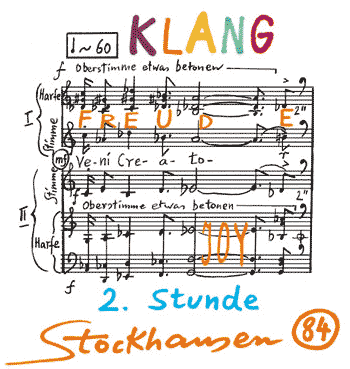
Fans of Oliver Kamm ((Would fans of Oliver Kamm, if such people exist, be likely also to read unspeak.net? I accept this is improbable.)) will be familiar with his charming habit of denouncing the recently dead in tones of stentorian conservatism. So it goes with his CiF post about Stockhausen, the newly late German composer. Unfortunately, Kamm is rather out of his depth on the topic of music, as can be deduced from the following hilarious passage:
The dominance of western music reflects its ability to combine melody and harmony, and thereby produce a discourse. A musical composition is above all an argument that appeals to the emotions. The work of Stockhausen is not like that.
The dominance of western music, eh? Where is it dominating? Is it that it is dominant in the west? Well, one might suppose that to be true by definition, as far as it goes.
Sadly, it goes nowhere. Because Kamm can’t really mean “western music” when he says “western music”. After all, Stockhausen was a European, and so quite western, composer. And the feature that Kamm supposes to be unique to “western music” — “its ability to combine melody and harmony” — is, of course, a feature of lots of other musics, from around the African continent, or India, or China, or Japan, and so on ad pretty much infinitum.
But let us give Kamm the benefit of the doubt. Perhaps what he is really thinking of is not “western music” but specifically a current in what is loosely termed “classical music”, viz., the contrapuntal tradition that issued in the great Renaissance polyphonists. In such music, harmony is created through the movement of independent voices, which is perhaps what Kamm really means by “its ability to combine melody and harmony, and thereby produce a discourse”.
Sadly for this generous interpretation, Stockhausen’s music, particularly his choral writing, contains many examples of counterpoint too.
What about the claim that “A musical composition is above all an argument that appeals to the emotions”? I once wrote a long review of Roger Scruton’s very interesting The Aesthetics of Music, in which the author rightly points out that such a childish view of music is untenable. (Even though Scruton himself nods at times, as when he somehow intuits that the opening bars of a Beethoven sonata “express a tranquil gratitude”.) Plainly it is fatuous to say that a musical composition is an “argument”, never mind an “argument that appeals to the emotions”; unless Kamm is able to précis for us the argument of Mozart’s 40th or Claire de Lune.
(Update: I somewhat misremembered Scruton’s analysis, which is that music can indeed “express” meaning, though not in the way Kamm implies: music is not, Scruton says, a “language”. In comments Mr Kamm offers a sentence from Scruton’s 2007 book Culture Counts, in which Scruton does argue that a piece of tonal music can have, though not be, an “argument”. It is rather illuminating, actually, to compare Scruton’s sentence with Kamm’s. Emphases have been added:
Scruton:
It is tonality, however, with its unique potential to synthesize the melodic and harmonic dimensions, that makes counterpoint and voice-leading intelligible to the ordinary musical ear, and so makes it possible for people not otherwise versed in musical theory to follow the argument of a symphony or a string quartet, and to understand the message addressed through tones to their emotions.
Kamm:
The dominance of western music reflects its ability to combine melody and harmony, and thereby produce a discourse. A musical composition is above all an argument that appeals to the emotions.
It is surely just coincidence that Kamm’s passage is so similar to Scruton’s. Kamm does not cite Scruton by name in his blog post, and so cannot have had this sentence in front of him when he wrote it. It would, of course, be absurd simply to substitute Scruton’s “tonality” with Kamm’s “western music”, since the two are not at all the same thing. Much Chinese music is just as tonal as Beethoven; and much western music is not tonal in the traditional sense.)
Reluctantly, then, I approach the conclusion that, on the subject of music, Kamm is cloth-eared and ignorant. Still, his blog post itself is, in a way, an “argument that appeals to the emotions”. You don’t really need to have listened to any Stockhausen to read it; nor, perhaps, to write it. All you have to do is swell with a vague emotional attachment to old-fashioned “western music” (not including Germans), and — evidently the real source of Kamm’s doltish animus against the composer — an emotional reaction against anyone who could have said that 9/11 was “the greatest work of art ever”.
Kamm is also fond of accusing various writers of disgraceful scholarship when they cite things while eliding context. In the interest of enabling unspeak.net readers to assess the level of disgrace that ought to attach to Kamm’s “scholarship”, I end this post by reproducing what Stockhausen said about 9/11 in full:
Well, what happened there is, of course — now all of you must adjust your brains — the biggest work of art there has ever been. The fact that spirits achieve with one act something which we in music could never dream of, that people practise ten years madly, fanatically for a concert. And then die. And that is the greatest work of art that exists for the whole Cosmos. Just imagine what happened there. There are people who are so concentrated on this single performance, and then five thousand people are driven to Resurrection. In one moment. I couldn’t achieve that. Compared to that, we are nothing, as composers. […] It is a crime because the people did not agree to it. They did not come to the “concert”. That is obvious. And nobody had told them, they could be killed. ((Source (pdf); translation: Wikipedia.))
40 comments
Hitchens on torture again
December 12, 2007 24 comments
Christopher Hitchens thinks the CIA ought to be abolished, according to his befuddled latest column in Slate. What is the latest example of its unfitness? Why, the destruction of those interrogation tapes from 2002. But wait. The reason the CIA destroyed the tapes, according to Hitchens, is a stunningly Machiavellian one:
At a time when Congress and the courts are conducting important hearings on the critical question of extreme interrogation, and at a time when accusations of outright torture are helping to besmirch and discredit the United States all around the world, a senior official of the CIA takes the unilateral decision to destroy the crucial evidence. This deserves to be described as what it is: mutiny and treason.
What exactly is Hitchens trying to say? Unspeak.net reader Peter offers his interpretation:
The implication of the word choice there, so far as I can see, is that the CIA is so set on destroying Bush, even though he’s about to leave office, that it has erased proof of its own agents’ innocence of torture.
Comical though it is, I believe Peter is right in thinking this is what Hitchens is saying: America doesn’t do “outright torture”, and so the CIA has destroyed the video proof that it doesn’t torture so as to hurt America’s reputation. Cunning! But let us trudge more slowly through this swamp.
The paragraph opens by contrasting two notions — that of extreme interrogation and that of outright torture. Now, Hitchens is tediously fond of saying, when it suits him, that a distinction between two things is a “distinction without a difference”, a term borrowed from the law. For example, there is a linguistic distinction between calling someone an “unmarried man” and calling him a “bachelor”, but no substantive difference in the claim of fact before the court. But Hitchens likes to use the concept more widely, glibly to shovel aside inconvenient phenomena. Earlier in this same column, for example, he calls the difference between civilian and military uses of nuclear power a “distinction without much difference”, which might be news to the IAEA.
But presumably Hitchens wants his distinction between extreme interrogation and outright torture to carry some weight, actually to denote a real difference. Extreme interrogation is a “critical question”, the kind of thing about which you soberly conduct “important hearings”; but “accusations of outright torture” are such as to “besmirch and discredit the United States all around the world”, and surely cannot be true.
But what exactly is extreme interrogation? Is it like being questioned by experts? Is it like extreme sports, say snowboarding or BMXing? Or is it more like that sportily named form of torture, waterboarding forced partial drowning? Is it the kind of thing it obviously makes sense to practise on extremists, since extremity of action is the only language they understand? Or is it just a wordcake that Hitchens impatiently ovened to denote the most macho possible interrogative behaviour that nonetheless falls short of what he, personally, without saying, considers “outright torture”?
We know, for example, that Hitchens smirkingly approves of “rough” interrogation in a fantasy “ticking-bomb” scenario, as he explained in this column in 2005. ((Discussed at length in Unspeak, pp180-2.)) Of course, that “rough” interrogation was itself torture. Is “extreme interrogation” even rougher? Are we finally invited, absurdly, to try to hold in our minds an idea of extreme torture, much worse than your ordinary kind of torture?
No, I don’t think it’s meant that way. Of course, Hitchens doesn’t say what he thinks “extreme interrogation” is, and how it fails to be “outright torture”. I suppose we can be sure, from his indignant protests about presumably ill-founded “accusations of outright torture”, that he thinks waterboarding forced partial drowning is not torture, since no one denies any more that waterboarding forced partial drowning has indeed been perpetrated against certain “high-value detainees” or clients or what have you. But waterboarding forced partial drowning is torture, and to call it even “extreme interrogation” is to trivialize it. So “extreme interrogation” vs “outright torture” is, in the end, a distinction without a difference. One is merely a clumsy euphemism for the other.
And yet, what power a clumsy euphemism has! It can make all the difference between America’s name being “besmirched” or not; and all the difference between the CIA’s destruction of tapes showing them doing what they were ordered to do by the administration representing a case of cover-your-ass, and it being a plot to bring down the government through “mutiny and treason”! Such is Hitchens’s commitment to obfuscatory Unspeak — even when, as here, it is quite sloppily executed.
Previously in “Christopher Hitchens”: Relatively less savage, Slower to get it, Some percentage, A proper account, High marks for efficiency, Sheltered.
24 comments
Guantanamo: therapeutic
December 11, 2007 5 comments
The range of terms available to describe people imprisoned for years without trial in Guantanamo Bay has always been revealing. Simply to call them “killers” or “terrorists”, as Cheney and Bush like to do, is of course to sidestep any irritating requirement of legal proof, and also to drown out the annoying fact that many of those imprisoned at Guantanamo have turned out to be innocent of any crime. As I pointed out in Unspeak, meanwhile, the fastidious official choice of the term “detainees” was probably first motivated by a worry that plainly to call them “prisoners”, which is what they are, would call to mind too easily the notion of a “prisoner of war” and thus the irksome existence of Geneva conventions detailing what may and may not be done to such prisoners.
Even after the Supreme Court decided that Common Article 3 does indeed apply at Guantanamo and so removed this Unspeak rationale, the designation “detainees” stuck. Perhaps because “detainee” also carries a useful implication of temporariness. If I say “I was detained on my way to the railway station”, you are likely to think that I experienced a few minutes’ delay, not that I was banged up in a prison cell for six years.
Now, with thanks to WIIIAI, we can observe an exciting new evolution in the naming of these unfortunates. People in Guantanamo Bay are not prisoners or even detainees but clients.
Such is the preferred language of a former interrogator at Guantanamo, who recorded this segment for NPR detailing how useful the prisoners were for her own spiritual journey:
When I returned to work, I began to meet again with my clients, which is what I chose to call my detainees.
Clients! It’s a good example, once again, of another theme in Unspeak — the way the language of commercial transaction can be called upon to smooth over and normalize any situation of violence, horror or injustice. Naturally, a pedant will point out that a man imprisoned in Guantanamo without trial is not exactly a client of his interrogators, if by “client” we understand a free agent choosing to solicit a service from a therapist or other specialist. But if we have already swallowed the description of torturers as experts and consummate professionals, and even of military spouses as service providers, then calling prisoners “clients” fits right in.
Or perhaps the interrogator is more learned in classics than we suspected, and she is consciously making reference to the sense of the original word cliens in Roman antiquity. Consider what the OED gives as the first meaning of our word “client”:
A plebeian under the patronage of a patrician, in this relation called a patron (patrōnus), who was bound, in return for certain services, to protect his client’s life and interests.
Ah, so in this set-up it is the client who performs the services. Well, that is just the story the interrogator tells:
My clients may never know this, but my year with them helped me to finally heal. My nightmares stopped.
I do love a happy ending, don’t you?
5 comments