
We will help you
Rebranding the US military
July 31, 2007 7 comments
What is going wrong with the US military adventure in Iraq? The problem, if you will believe it, is simply that they do not have a convincing brand identity. Such is the conclusion of a “study” or piece of “research”, as it is pleased to call itself, which was described in the Washington Post recently:
In the advertising world, brand identity is everything. Volvo means safety. Colgate means clean. IPod means cool. But since the U.S. military invaded Iraq in 2003, its “show of force” brand has proved to have limited appeal to Iraqi consumers, according to a recent study commissioned by the U.S. military.
The key to boosting the image and effectiveness of U.S. military operations around the world involves “shaping” both the product and the marketplace, and then establishing a brand identity that places what you are selling in a positive light, said clinical psychologist Todd C. Helmus, the author of “Enlisting Madison Avenue: The Marketing Approach to Earning Popular Support in Theaters of Operation.” The 211-page study, for which the U.S. Joint Forces Command paid the Rand Corp. $400,000, was released this week.
Helmus and his co-authors concluded that the “force” brand, which the United States peddled for the first few years of the occupation, was doomed from the start and lost ground to enemies’ competing brands. While not abandoning the more aggressive elements of warfare, the report suggested, a more attractive brand for the Iraqi people might have been “We will help you.” ((Thanks to reader Craig for alerting me.))
There is something naggingly wrong with this military-as-brand metaphor, as implied by the Post reporter’s nicely ironical use of the word “consumers” to describe Iraqis at the sharp end of US military action. Iraqis, as far as is known, did not ask to be invaded and blown up; and indeed, so far as is known, do not want the US to stay in their country. This is not much like the situation in consumer goods, where I have never been forced to own an iPod or Volvo that I did not ask for. Still, let us see a little of what Americans got for their four hundred thousand tax dollars, by consulting the full text of the RAND report. ((I admit here that I have not read all 241 pages of it, having become distracted somewhere along the way by daydreams of how I might have positioned Unspeak as a think tank “research” “study” and thereby earned barnfuls of dollars, instead of having it published normally, like an idiot.)) The right way to win hearts and minds before an invasion, it seems, is to deliver an appropriate “positioning statement”:
Consider one positioning statement example that is derived from a hypothetical “free from tyranny” concept: To [insert indigenous target audience] who have lived under brutal oppression: U.S. forces will rid your country of tyranny [promise] because we have opposed it for 200 years [reason to believe] and support your living free from tyranny [emotional and benefit]. [p70 n34]
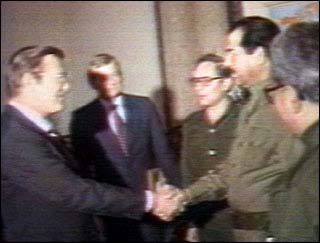
It is a good thing that the authors cover their collective ass by calling this a “hypothetical” “concept”, even though it sounds remarkably like the kinds of things that were said, and are said, about Iraq. This particular version of it imagines the “hypothetical” lucky people to be invaded as idiots, or at best children, who will apparently swallow trustingly the notion that the US has indeed opposed tyranny for 200 years, that being the “reason to believe” that the claimed motivations for the incipient invasion are actual. The imminent “consumers” of military might, naïve and historically ignorant as all such “indigenous” peoples may safely be assumed to be, certainly wouldn’t remember anything like this, would they?
“Reason to believe”, indeed. But what purpose would such a “positioning statement” serve, if bought?
We posit that engendering positive indigenous attitudes toward U.S. military presence is important in that it will encourage support of the U.S. military, make U.S. forces more approachable to civilians, and enable more effective and trustworthy communications. [p. 75]
No doubt. So then, how exactly to “engender positive indigenous attitudes toward U.S. military presence”? By refraining from killing civilians or torturing people? Don’t be silly. All that’s needed is a brand refocus, or “Developing a coherent external and internal branding strategy”. This can be done, it turns out, by heroic private enterprises:
A private, nonprofit business group, Business for Diplomatic Action, is currently creating a unique and successful brand-development process for the U.S. Travel Industry Association with the goal of portraying a clear and friendly U.S. identity to those visiting from overseas. Business for Diplomatic Action consults key organizational stakeholders to create an intended brand identity that resonates deeply within those organizations while also being attuned to key consumer audiences. We recommend that the U.S. military and, ideally, the U.S. government consider undergoing such a branding process. It may reveal previously unforeseen ways to create an internal and external identity that successfully encompasses the operational spectrums that are likely to challenge the U.S. military for years to come. In suggesting how such a brand strategy might be applied to the United States, Business for Diplomatic Action’s chair, advertising guru Keith Reinhard, suggests a simple yet elegant promise: “We will help you.” While his recommendation was meant for U.S. foreign policy, the “helping” promise may be a positioning message applicable to the military. It provides an intent for U.S. forces that covers the application of combat power while also meeting the test for a range of other operations. It serves as a message of inspiration for indigenous audiences, one that encompasses — and thus would not conflict with — a wide variety of potential end states. [p. 77]
There is no limit, it appears, to how credulous these childlike “indigenous” consumers of being-blown-up-by-cluster-bombs are. Tell them that being-blown-up-by-cluster bombs is actually helping them and they will go for it! They will, in fact, take it as “inspiration”! Still, it must be admitted that there are limits to how far this branding magic can go:
The U.S. military must take pains to ensure that its operations and other actions do not conflict with intended brand identity, shaping themes, or other strategies designed to earn popular support among local populations. However, the United States and its allies must, at times, risk popular support by conducting kinetic operations. Virtually any kinetic operation has the potential to alienate civilians. [p. 80]
Yup, particularly if it kills them. And here, indeed, resides the melancholic limit of the authors’ scheme: “kinetic operations”, or bombing and shooting people, are inevitably the core of what any military is for. And, despite the authors’ subsequent efforts to suggest that saying sorry and promising to fix things will make it all better, even really great branding won’t overcome the extreme alienation of your average dead civilian.
This report’s use of currently fashionable “branding” theories is consistent with the US military’s history of describing its operations in terms of commerce, so that it appears to be business as usual. ((Unspeak, pp113-114.)) Even so, it looks particularly, even decadently desperate right now, as an Unspeak tactic for reframing inconvenient realities.
 7 comments